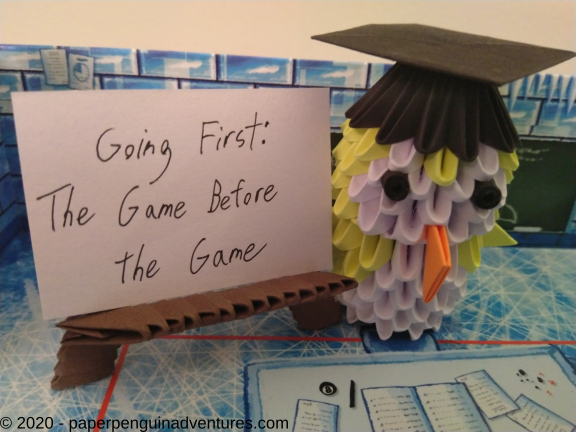
Professor Macroni: Many of you probably think that all the preparation you need to win a board game is to sit down and play…
Student 1: What about for games that don’t require sitting down?
Student 2: You mean sports?
Student 1: Escape: Curse of the Temple can definitely be played without sitting down.
Professor Macroni: Irrespective, of whether the game requires actually sitting down, it is commonly accepted that the game begins with the first turn. However, what many fail to take into account is that they can control who that first player is. Combine that with the fact that first player advantage is a thing, we see that it’s worth some effort to make yourself the first player. That is the topic of today’s lesson.
There are many methods for generating a first player which we can break down into 6 main categories: fun methods usually unique to the game, a specified role always going first, some sort of random selection, having the players decide arbitrarily, using the ages of the players, and finally games that don’t properly have a first player due to turns being taken simultaneously.
Random selection is the most common method with almost two thirds of these games further specifying a specific method of selection like roll a specific die. If a specific method is specified, there’s not much you can do. If no method is specified, we can take advantage of the loophole that it never specifies a uniformly random distribution meaning making your odds 90% and everyone else’s 2.5% is perfectly allowed. Of course, you have to be a bit sneaky to avoid people noticing that. Betting on a random number generator your opponents haven’t looked too closely at is probably the best bet (If you have a large stack of money, bribing the creator of Chwazi for a rigged version may be possible). Thus we have the first actionable pre-game step: Acquire a biased random number generator.
If going first is determined by role, just get the role that goes first. Easy, unless there’s contention for that role in which case you’ll often just use one of the other methods to determine who gets that role in the first place.
For games that have players acting simultaneously, you may think you can’t go first. Wrong. In real time games like Escape: Curse of the Temple, going first comes down to being the fastest, so we have our second actionable item: Don’t neglect physical exercise.
Student 1: But professor, isn’t Escape a coop…
Professor Macroni: Many games take the boring approach of giving players leniency to decide among themselves who goes first. In these cases there are a few possible strategies.
The first is to simply respond “Me!” first when someone asks who’s going first. Oftentimes nobody will bother to contest.
The second option simply to propose it be done randomly and then use one of the strategies from the previous set of rules
The third strategy is being the only one to know the game. Oftentimes players will be intimidated by the new game and be glad to let you take your turn first so they have the chance to watch. Thus learning the rules before the game is the third action item. This strategy is highly group dependent however and can backfire if they demand you go last since you already have an advantage. Usually still a good idea as it prevents issues like poor rules explanations from hurting your chances.
The age category is composed of “youngest goes first” and it’s sibling “oldest goes first.” Between youngest and oldest, it’s surprisingly equal in the games you’ll likely encounter, though middle siblings get screwed when playing with family. This brings us to the 4th piece of actionable advice: Choose your playgroup so that you are the oldest or youngest member. Not always possible, but pretty much the only thing you can do to influence first player in this case. The one exception is if you were born on Feburary 29th, in which case you can try to get away with claiming to be only 1/4th as old as you actually are.
Last and most certainly not least is the various “fun” methods of determining first player. These are almost always game specific, and require learning them on a per game basis. The upside is these are the easiest to steal from other players. For example, Coup has an easy method, you just need to win the previous game. After my course that should be no problem. Lost Legacy has the trickiest one, you need to inherit an “awesome legacy”. I suggest a good debate course so no matter how bad yours may seem at first you’ll be able to argue it’s best.
Now since we’re running out of time I won’t do an in depth analysis of the methods for the rest of the games. Instead, I have the following routine you can follow daily to ensure first place.
Remember when I said exercise is important? That exercise should take the form of biking which will make you healthy and more godlike than all of your peers. As such, you will gain many admirers, let them know you appreciate them by blowing them kisses. Be sure to bike by a zoo to see a penguin (That part is only needed for any humans that may be eavesdropping). Also, swing by some flowers on your way and water them as you bike past.
After your rides, eat a handful of dates to recover. Then go shower, you can’t win games if people don’t want to play with you. Be sort of careless while doing so and don’t stop showering until you’re clean (if you can manage to swallow some water accidentally, great!) Also be sure to change into your most colorful outfit afterwards. So that you keep getting ever more colorful and awesome clothes, I suggest weaving a new color thread into your clothes every time you put them on. Since you will quickly have so many colors, I recommend writing down with a nice gel ink pen which colors you have already used.
Homework questions:
- What board games will my daily routine get you first player for?
- This lesson assumes that you want to go first, name 5 times where this is not the case and how to avoid being forced to.